Why Does My Breath Still Smell After Brushing?
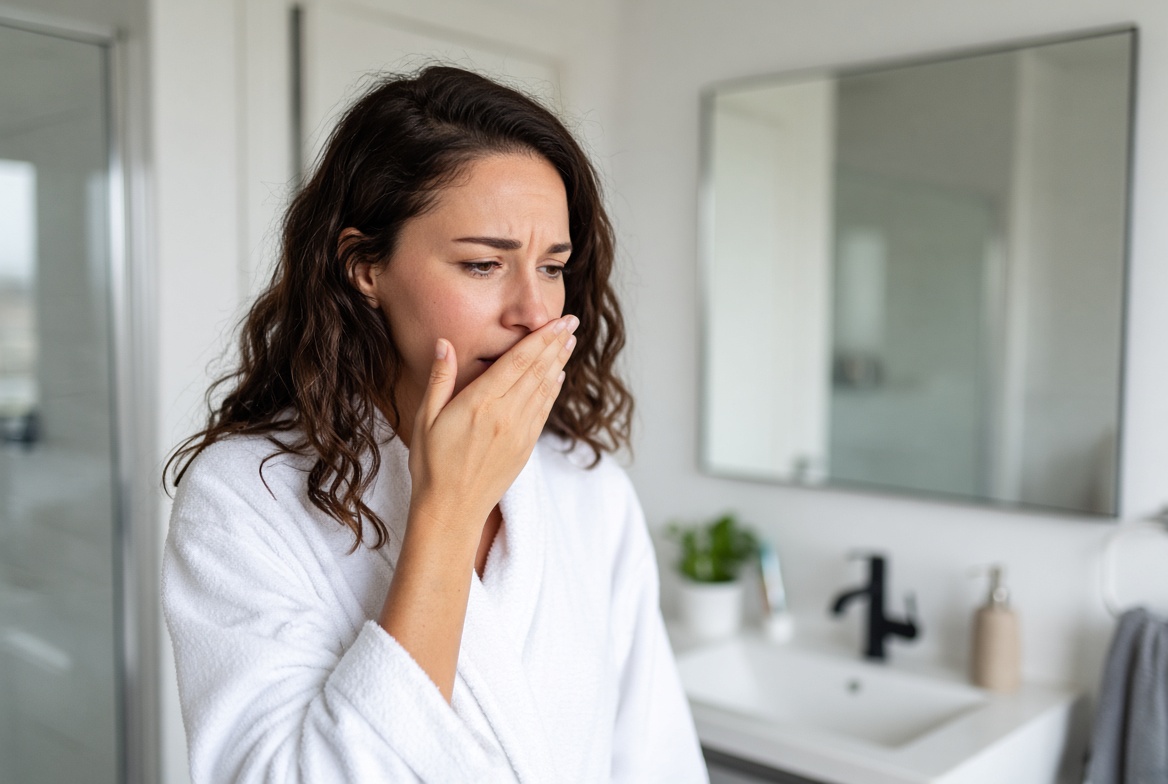
You brush your teeth. You rinse your mouth. Maybe you even chew gum or use mouthwash. Yet a few hours later, you notice that your breath doesn't seem as fresh as it did before.
If that sounds familiar, you're not necessarily doing anything wrong. Brushing is essential for oral health, but it isn't the only factor that affects how your breath smells.
Quick answer: Bad breath can be influenced by bacteria, tongue buildup, plaque, food particles, dry mouth and other oral-health issues. If the problem keeps returning, it's worth looking beyond your toothbrush and considering what's happening throughout your mouth.
Brushing Isn't the Whole Story
Your toothbrush removes a lot of plaque and food debris from the surfaces of your teeth. But your mouth contains many other areas where bacteria and debris can accumulate.
Your tongue is one example. Its surface contains thousands of tiny structures that can trap food particles, mucus and microorganisms.
The American Dental Association notes that volatile sulfur compounds are important contributors to oral malodor. These compounds can be produced when microorganisms break down substances in the mouth.
This is one reason someone can brush their teeth thoroughly and still have unpleasant breath later.
Don't Forget Your Tongue
If you only brush your teeth, your tongue may be getting overlooked.
A buildup on the tongue can contribute to unpleasant breath. Gently brushing your tongue or using a tongue cleaner can therefore be a simple addition to your routine.
You don't need to scrub aggressively. The goal is simply to clean the surface without irritating it.
Your Mouth Is an Ecosystem
One of the more interesting things about oral health is that your mouth isn't supposed to be free of bacteria.
In fact, your mouth is home to a large community of microorganisms. Different bacteria interact with one another and with their environment, including your saliva, tongue, teeth and gums.
The goal isn't to eliminate every microorganism. Instead, oral health is partly about maintaining an environment where harmful bacteria don't overwhelm the rest of the ecosystem.
This is where the idea of the oral microbiome comes into the conversation.
What About Mouthwash?
Mouthwash can certainly make your mouth feel fresher. But there's an important distinction between temporarily masking bad breath and addressing the factors that contribute to it.
Some mouthrinses are designed primarily to provide a temporary freshening effect, while therapeutic mouthrinses can contain ingredients intended to help control specific oral-health problems.
If your breath consistently becomes unpleasant again shortly after using mouthwash, that doesn't necessarily mean you need a stronger mouthwash. It may be worth looking at the underlying reason instead.
Could Oral Probiotics Help?
You've probably heard about probiotics for gut health. The same general idea has also attracted interest in oral health.
Oral probiotics are products containing specific microorganisms that are intended to interact with the microbial environment in the mouth.
Research into oral probiotics and bad breath is interesting, but the evidence isn't as simple as saying that probiotics will solve bad breath for everyone.
Some clinical studies and reviews have reported improvements in measures associated with halitosis, while researchers have also pointed out differences between studies, bacterial strains, dosages and treatment periods.
In other words, the idea is promising, but strain-specific evidence matters, and more research is still needed.
7 Things You Can Try for Fresher Breath
1. Clean your tongue
Add gentle tongue cleaning to your normal brushing routine. This can help remove material accumulating on the tongue's surface.
2. Clean between your teeth
Floss or use another suitable interdental cleaner to remove food and plaque from areas your toothbrush can't reach.
3. Drink enough water
Saliva plays an important role in the mouth. A dry mouth can contribute to bad breath, so staying hydrated can be helpful.
4. Pay attention to when the smell returns
Does it happen after coffee? In the morning? After certain foods? Or just a few hours after brushing?
Looking for a pattern can sometimes tell you more than simply trying another toothpaste.
5. Don't rely entirely on mints
Mints and gum can make your breath feel fresher, but they're generally a short-term solution. If bad breath keeps returning, consider why.
6. Keep the basics consistent
Brush twice a day with fluoride toothpaste and maintain regular dental care. New products shouldn't replace the fundamentals of oral hygiene.
7. Consider the oral microbiome
If you've already addressed the basics and you're interested in the emerging area of oral probiotics, you may want to learn more about how these products work and what the research actually says.
What About ProDentim?
ProDentim is one product marketed in the oral-probiotic category. Its formulation includes probiotic strains such as Lactobacillus paracasei, Lactobacillus reuteri and Bifidobacterium lactis BL-04, along with other ingredients.
It's important to distinguish between research into particular probiotic strains and evidence for a specific commercial product. Research on one probiotic strain doesn't automatically prove that every product containing probiotics will produce the same result.
If you're curious about the product, you can read the manufacturer's information, ingredients and current offers before deciding whether it is something you want to try.
Want to Learn More About ProDentim?
If you're interested in exploring an oral probiotic product, you can take a look at ProDentim and review the ingredients and product information for yourself.
See ProDentimThe Bottom Line
If your breath still smells after brushing, the answer may not be as simple as needing a better toothbrush or stronger toothpaste.
Tongue buildup, plaque, food particles, dry mouth and the microorganisms living in your mouth can all play a role in oral odor.
Start with the basics: brush properly, clean between your teeth, clean your tongue, stay hydrated and maintain regular dental care.
And if you're interested in oral probiotics, look at the evidence with a critical eye. Some research is encouraging, but results can depend on the particular probiotic strains being studied.
Most importantly, persistent or unexplained bad breath shouldn't simply be covered up indefinitely. If the problem continues despite good oral hygiene, a dentist can help determine whether there's an underlying oral health issue that needs attention.